
Understanding IRAs — Your Retirement Money’s Best Friend
💰 Understanding IRAs — Your Retirement Money’s Best Friend
A lot of people hear the term “IRA” and immediately think “some complicated tax thing my accountant handles.”
But really, it’s just a special account designed to help you save for retirement — with tax benefits.
Let’s break it down simply 👇
🔹 What Is an IRA?
IRA = Individual Retirement Account.
It’s not an investment itself — it’s a container where your investments (stocks, bonds, funds, etc.) grow with special tax treatment.
Think of it as:
A retirement “wrapper” that tells the IRS how your money should be taxed (or not taxed).
🧩 The Two Main Types
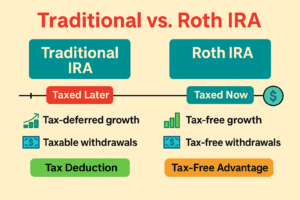
1️⃣ Traditional IRA
-
You contribute pre-tax dollars (money you haven’t paid tax on yet).
-
Your money grows tax-deferred — meaning no tax each year as it grows.
-
You pay tax when you withdraw in retirement.
-
Good for: People expecting to be in a lower tax bracket when they retire.
🧾 Tax Tip: You may get a tax deduction for contributions (subject to income limits).
2️⃣ Roth IRA
-
You contribute after-tax dollars (money you’ve already paid tax on).
-
Your money grows tax-free.
-
You withdraw it tax-free in retirement (if rules are met).
-
Good for: People expecting to be in a higher tax bracket later or wanting tax-free income in retirement.
✨ Biggest advantage: Tax-free growth forever — no tax when you take it out (after age 59½ and 5 years).
⚖️ Quick Comparison
| Feature | Traditional IRA | Roth IRA |
|---|---|---|
| Contributions | Pre-tax (may be deductible) | After-tax (no deduction) |
| Growth | Tax-deferred | Tax-free |
| Withdrawals | Taxable | Tax-free (qualified) |
| Best for | Lower taxes later | Higher taxes later |
| Age limit | Contribute until 70½ (if working) | No age limit (if income eligible) |
💡 Bonus: SEP IRA & SIMPLE IRA
For business owners or freelancers, these versions allow bigger contributions:
-
SEP IRA: Great for self-employed; higher limits, flexible.
-
SIMPLE IRA: For small businesses; employer and employee contributions allowed.
🚫 Early Withdrawal Rule
Taking money out before age 59½ usually triggers a 10% penalty + tax,
unless you qualify for exceptions (like first-time home purchase, education expenses, or disability).
📘 Real Talk
You don’t have to be rich to open an IRA.
Even small, consistent contributions can turn into a significant retirement fund thanks to compound growth and tax advantages.
The earlier you start, the more your money works — not the IRS. 💪
