
Why choose an S-Corp over a standard LLC?
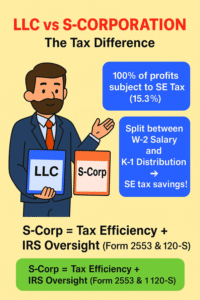
A regular LLC is simple to operate — but here’s the catch:
➡️ The entire profit is usually subject to Self-Employment (SE) tax.
💼 S-Corporation Highlights
✅ Reduces SE tax burden
✅ Files Form 2553 to elect pass-through treatment
✅ Avoids double taxation (no corporate-level tax)
⚖️ The Key Difference
-
Salary (W-2): “Reasonable compensation” paid to the owner — subject to payroll/FICA taxes.
-
Distributions (K-1): Remaining profit — not subject to SE tax.
💡 Example
A solo consultant earns $150,000 in net profit:
Scenario 1 – Standard LLC/Sole Prop
→ Entire $150,000 × 15.3% SE tax = $22,950
Scenario 2 – S-Corporation
→ Pays themselves $80,000 salary (W-2)
→ Takes $70,000 as distribution (K-1)
→ FICA on salary = $12,240
💰 S-Corp saves over $10,000 in FICA taxes.
⚠️ Important: Reasonable Compensation
If you underpay yourself (say, $10K salary + $140K distribution), the IRS can reclassify part of that distribution as salary — leading to back taxes, interest, and penalties.
A “reasonable” salary is what your business would pay an unrelated employee for the same role.
✅ Advantages
-
Significant tax savings on distributions
-
Limited liability protection (same as LLC)
❌ Disadvantages
-
Payroll setup required
-
Quarterly filings (Form 941)
-
Owner must receive W-2
-
Must file Form 1120-S
-
IRS scrutiny of “reasonable compensation”
❓ Common Question:
Q: An S-Corporation can only have certain types of shareholders.
What is the maximum number of shareholders an S-Corp is allowed to have?
A: The IRS allows up to 100 shareholders — and all must generally be U.S. citizens or resident individuals.
(S-Corps cannot have partnerships, corporations, or nonresident aliens as shareholders.)
Bottom Line:
S-Corp status can be a smart tax move for profitable small businesses —
but it comes with extra admin responsibilities and IRS compliance.
